Back to School Making Inferences Pack: Turning Little Learners into Reading Detectives
The beginning of the school year is a time filled with excitement, new routines, and the anticipation of learning. However, for many educators and parents, it also brings the challenge of assessing where students stand in their reading abilities. One of the most critical skills that bridges the gap between decoding words and truly understanding text is making inferences. Often described as "reading between the lines," this skill is foundational for literacy but can be abstract for young minds. Enter the Back to School Making Inferences Pack, a specialized resource designed to kickstart the school year by transforming Kindergarten, 1st Grade, and 2nd Grade students into confident reading detectives.
What Does It Mean to Be a Reading Detective?
To understand the value of this activity pack, we must first demystify the concept of inference. In the simplest terms, an inference is a conclusion reached on the basis of evidence and reasoning. When children read, they do not just see words; they must combine what is written on the page with what they already know from their own lives to understand the deeper meaning. For example, if a story says, "Sarah pulled her hood up tight and shivered," a child who can infer understands that Sarah is cold, even though the word "cold" was never explicitly stated.
For early learners, this cognitive leap can be difficult. They often struggle to distinguish between facts (what is directly stated) and inferences (what is implied). This is where the Making Inferences Pack shines. By framing the activity as a detective mission, the resource leverages the natural curiosity children possess. The prompt "Become a Reading Detective" encourages students to look for clues within the text and illustrations to solve the mystery of the story's hidden meaning. This approach makes the learning process engaging rather than tedious, turning a complex cognitive task into an adventure.
A Tailored Approach for Early Elementary Students
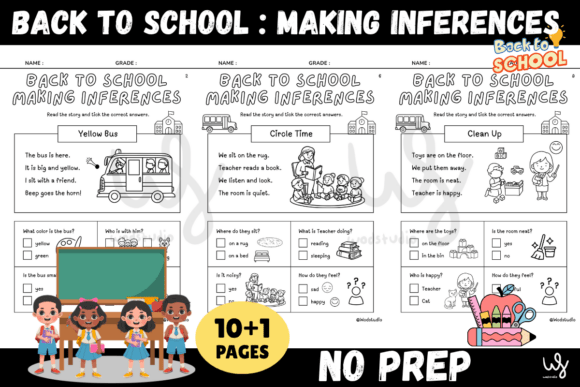
One size does not fit all when it comes to education, which is why this 10-page pack is specifically curated for Kindergarten, 1st Grade, and 2nd Grade. These developmental stages require materials that are visually stimulating yet cognitively accessible. The pack addresses this by utilizing simple stories and adorable illustrations that capture a child's attention without overwhelming them.
The content covers relatable back-to-school themes that resonate with young students immediately. Topics such as The Yellow Bus, New Backpack, My Teacher, and Fun Colors provide familiar contexts. When a student reads about a yellow bus, they bring their own experiences of waiting for the bus or riding in one to the table. This prior knowledge acts as the scaffold upon which they build their inferences. If the story mentions a child looking at their watch while standing near the bus stop, the child can easily infer that the character is waiting anxiously or is late, using the visual clue of the watch combined with the context of the bus.
The Power of Visual Support
A standout feature of this resource is its emphasis on visual support. The charming hand-drawn line art style serves a dual purpose. First, it provides a coloring activity that allows for creative expression and fine motor skill practice. Second, and more importantly, these illustrations act as concrete evidence for the questions asked. For students who are still developing fluency, the images provide the necessary context to answer questions correctly. This is particularly beneficial for ESL (English as a Second Language) and ELL (English Language Learner) students, who may struggle with complex vocabulary but can grasp meaning through pictures. By pairing visual cues with textual evidence, the pack ensures that all learners have an equitable opportunity to succeed.
Why Evidence-Based Questions Matter
Reading comprehension is not merely about guessing; it is about supporting your answers with proof. The pack includes evidence-based questions that guide students through this critical thinking process. Instead of asking open-ended questions that might lead to vague answers, the activities prompt students to identify specific details in the text that lead to their conclusion.
This method aligns with modern educational standards that emphasize critical thinking over rote memorization. By practicing how to point to a sentence or an image that proves their idea, students develop a habit of rigorous analysis. This skill set extends far beyond the classroom. In the real world, the ability to analyze information, weigh evidence, and draw logical conclusions is essential for decision-making in business, technology, and daily life. Starting this training in Kindergarten lays the groundwork for a lifetime of analytical thinking.
Practical Applications for Educators and Parents
Flexibility is key in any educational resource, especially during the chaotic start of a school year. The Back to School Making Inferences Pack is designed as a No-Prep solution, saving teachers valuable planning time. The activities are formatted in high-resolution PDF files, sized perfectly for A4 printing, ensuring that the quality remains crisp whether printed for a single student or a whole class.
- Literacy Centers: Teachers can place these worksheets in rotating centers, allowing small groups to work independently on inference skills while the teacher focuses on other needs.
- Morning Work: The clear structure makes these pages ideal for morning bell ringers, setting a productive tone for the day and activating students' brains immediately.
- Small Group Intervention: For students who need extra support, these targeted exercises provide a focused way to build confidence in reading comprehension.
- Homework or Homeschooling: The inclusion of an Answer Key makes the pack perfect for home use. Parents can easily check their child's work, facilitating self-checking and fostering a sense of independence.
Bridging the Gap Between Fun and Learning
Sometimes, there is a misconception that "fun" activities lack academic rigor. However, this pack demonstrates that engagement and education go hand in hand. The combination of coloring fun and literacy practice ensures that students remain motivated. When a child enjoys the process of coloring the "Yellow Bus" or drawing a "New Backpack," they are less likely to resist the accompanying reading tasks. This positive association with reading is crucial for building a lifelong love of books.
Building a Strong Foundation for Future Success
The ultimate goal of the Back to School Making Inferences Pack is to help little learners master the art of reading between the lines. By providing 10 engaging stories and a comprehensive answer key, the resource offers a complete toolkit for the first weeks of school. It addresses the diverse needs of the classroom, from early readers needing visual aids to advanced students ready for logical challenges.
In an era where information overload is common, the ability to discern fact from implication is more important than ever. By equipping students with these detective skills early on, educators and parents are not just teaching them to read words; they are teaching them to think critically about the world around them. Whether used in a bustling classroom or a quiet homeschool corner, this 10-page pack is a powerful tool to ensure every child starts their academic journey with the confidence to solve the mysteries hidden in the text.
As you prepare for the upcoming term, consider how these resources can transform your approach to literacy instruction. With its focus on evidence, visual support, and engaging themes, the Back to School Making Inferences Pack is more than just a worksheet collection—it is a stepping stone toward becoming a true reader.